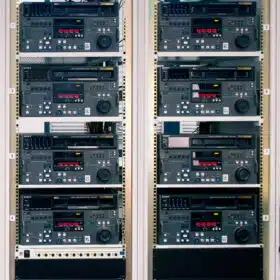
Betacam
Overview of the SONY Betacam Formats
Developed by SONY, the Betacam family of formats played a central role in professional video production from the 1980s through the early 2000s. Each generation brought technical improvements suited to the evolving needs of broadcasters, newsrooms, and production studios.
-
Betacam (1st Generation)
Introduced in the early 1980s, this analog ½-inch format used oxide tape and quickly became a professional standard.
-
Betacam SP
Launched in the mid-1980s, Betacam SP featured metal particle tape, providing higher signal quality and durability. It became the dominant format for broadcast production for over a decade.
-
Digital Betacam (DigiBeta)
Released in the 1990s, this digital format offered exceptional image fidelity, enhanced resolution, and superior color depth.
-
Betacam SX
Also introduced in the 1990s, SX used digital compression. It was favored for electronic news gathering due to its cost-efficiency and reliability.
-
Betacam IMX
Debuting in the early 2000s, IMX delivered MPEG-IMX compression at 30 to 50 Mbps, balancing quality and storage efficiency. It was widely used in broadcasting before the transition to file-based workflows and HD formats.
Mostrando todos los 9 resultados